.png)
.png)
In a world where bullying and youth mental health are significant concerns, it becomes imperative for caregivers, parents, and teachers alike to foster a culture of kindness and empathy in children at an early age. Kids ‘R’ Kids shares the role of compassion and empathy in an individual's success and how caregivers can help build this quality in children.
Understanding and respecting another person’s perspective is the foundation for a kind and compassionate character. “Empathy is hardwired in us from birth through what's known as the mirror-neuron system, and we intuitively feel what others feel,” explains psychiatrist Kelli Harding, M.D.
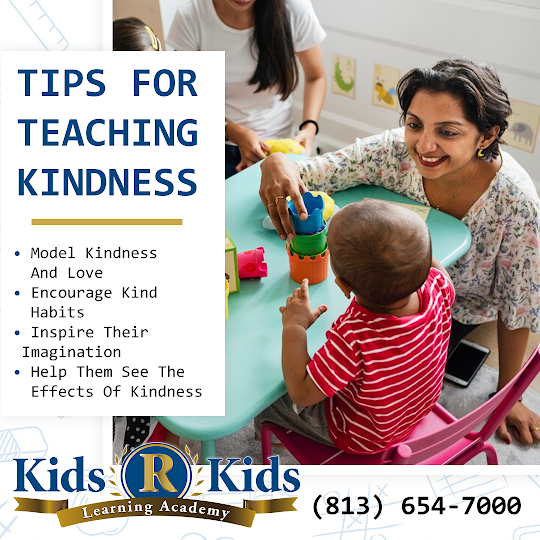
Children imitate their caregivers. So the best way to teach kindness is to practice it. When children observe their parents or teachers being kind to others, they also imitate this behavior. Service begins at home or in classrooms and spreads out into the world. Simple gestures like showing affection with hugs and kisses and saying please and thank you around the house greatly impact children. Moreover, it’s never too early to talk about kindness and generosity with children.
Kindness and empathy are abstract concepts. But connecting them with concrete verbs and actions such as sharing, volunteering, giving, including comforting, supporting, championing, compromising, and listening, helps understand what kindness means. Helping a family member with a chore or offering a seat to an older person are great examples to share. These habits are intertwined with etiquettes and gracious actions such as saying please and thank you.
To be in another person’s shoes and have the ability to empathize with another human being is a powerful skill. Inspiring children to imagine another person’s situation and feelings can help them resolve complicated real-life social problems as they grow up. Asking questions such as, “She fell and scratched her knee, what should we do?” Pretend play is also an effective way to practice empathy with kids.
Various studies have shown that toddlers enjoy giving treats more than receiving them because giving allows them to witness the joy a recipient feels due to the generosity. Children are hardwired to be kind. All they need is encouragement and the right environment. To teach them kindness and empathy, caregivers can involve them in activities where they can see the impact that they are making. Activities such as writing gratitude letters or thank you notes and donating food to charities allow them to see the effect of kindness.
The “Hug First, Then Teach” philosophy defines every aspect of what Kids ‘R’ Kids, Circa Fishhawk, stands for. Unlike many daycare centers or childcare providers, its methodology is a whole-child approach. It constantly strives to strengthen and encourage every child’s emotional, intellectual, social, and physical well-being through the expertise of its childcare providers and a unique partnership with parents.
Kids ‘R’ Kids International is accredited by AdvancED®, the world’s largest education community, and the Southern Association of Colleges and Schools Council on Accreditation and School Improvement (SACS/CASI). SACS/CASI is an accreditation division of AdvancED®. This accreditation ensures that the high accreditation standards are met and exceeded.
Children, just like adults, manage changes best if they are expected and occur within the premise of a familiar routine. A predictable routine forms the foundation that allows children to feel safe, and feel confident enough to handle themselves better. As they master this ability to handle smaller changes, they can slowly begin to manage bigger changes, which is important for their growth. Kids ‘R’ Kids, an educational preschool, explains different ways in which routines help foster happier and stable children.
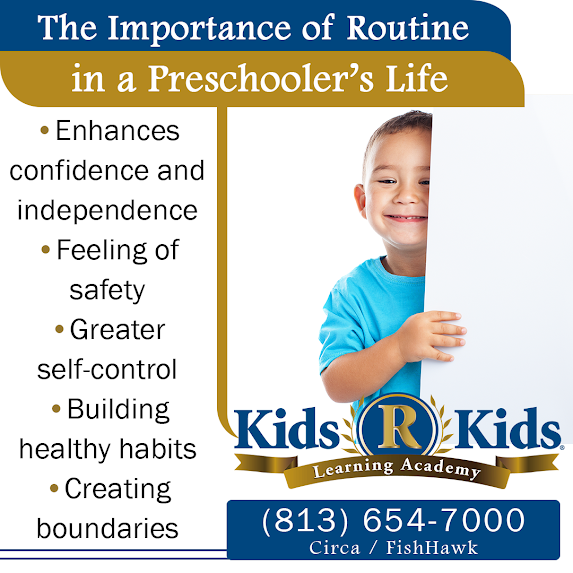
This creation of boundaries is also important for the parents to manage their lives better and avoid the power struggle as much as possible.
Every child and every family is different. Therefore, every routine should be designed based on a family’s unique situation and needs. Here are some basic outlines of a routine for a preschooler:
Routines are crucial to give some structure and predictability to a child’s life but at the same time, a child should have time for free play. Free unstructured time allows children to manage unpredictability and change.
The philosophy of “Hug First, Then Teach”, defines every aspect of what Kids ‘R’ Kids, Circa Fishhawk stands for. Unlike many daycare centers or childcare providers, its methodology is a whole-child approach. It constantly strives to strengthen and encourage every child’s emotional, intellectual, social, and physical well-being through the expertise of its childcare providers and a unique partnership with parents.
Kids ‘R’ Kids International is accredited by AdvancED®, the world’s largest education community, and the Southern Association of Colleges and Schools Council on Accreditation and School Improvement (SACS/CASI). SACS/CASI is an accreditation division of AdvancED®. This accreditation ensures that the high accreditation standards are met and exceeded.
Call today at (813) 654-7000 to learn more about the Kids ‘R’ Kids before and after school programs (Kindergarten to Grade 5) or to schedule a visit.
Contact Information:
Kids 'R' Kids Learning Academy of Circa / FishHawk
5815 Kids Crossing Drive
Lithia, FL 33547
United States
Keith Balot
(813) 654-7000
http://www.krkcirca.com/
Parents and teachers are the two most important influences in a young child’s life and development. Parents are a child’s first teacher as they can teach essential life and academic skills while providing love and support. Parents are also a crucial link between children and their preschool.
Several studies have proven that collaboration between parents and teachers improves children’s academic achievement, work habits, social skills, and emotional well-being. Especially since the pandemic, the collaboration between educators and parents has become the foundation of the early childhood education system in the ‘new normal’. It has become crucial for all the stakeholders to come together to support this partnership to ensure that children receive seamless education, irrespective of the pandemic.
Kids ‘R’ Kids, Circa Fishhawk discusses how positive parent and teacher partnership can impact student success:
Children become more invested in their classroom learning when they notice the positive connection between parents and teachers. The evident connection between both parties makes children develop a unique trust in their teachers.
The preschoolers see how their teachers involve and respect their parents. This connection allows parents and children to communicate about the classroom activity. This involvement from parents excites children and they look forward to sharing their successes.
When there is an established trust and a connection between the three parties, namely the parent, teacher, and child, problems are simply challenges that can be overcome together. Tough discussions are not avoided as there is comfortable candor that has been developed over time. Teachers can freely communicate a student challenge while parents can instill more trust in the teacher’s perspective due to the prevailing connection. Additionally, preschoolers feel safe and comfortable about facing any learning challenges as they view the parents and teachers as their cheerleaders. All challenges are solved together as a team that is dedicated to the achievement of a common goal - the child’s learning and growth.
When there is collaboration, the preschoolers’ milestone achievements are more meaningful. The development of a motor skill, overcoming social anxiety, making new friends, the first stage recital, eating a meal independently - all these priceless accomplishments prove that the student, teacher, and parents are aligned in their goals and are a successful team.
The teamwork between parents and teachers is the biggest boost for preschoolers’ learning as it creates a strong home-school connection. Here a few things parents can do to strengthen the school-home connection for their preschooler by collaborating with the preschool teachers:
With work schedules running haywire with or without the pandemic, it may seem challenging to contribute to a child’s learning. But it is possible to fuse learning and fun into the time being spent with children. Being available during play dates, cuddling on the sofa while watching an animation, complimenting the child on their small yet meaningful achievements, doing no-fire cooking together, or just taking a stroll in the garden are several ways to bond with a child. These are quality activities that are beyond the daily chores and are very important for a strong parent-child bond. This constant connection enables a parent to be engaged in every aspect of a child’s life, including school. As children communicate more during these quality sessions, any challenges and hurdles in learning will also be discussed and resolved naturally.
Participating in a child’s education may have several meanings. It could mean helping children with homework, returning notes and sending project material on time, and attending a parent-teacher conference when needed. But it can include much more. For instance, working with a teacher to support classroom learning while simultaneously providing insight into the child’s psyche to teachers. Informing the teachers about the child’s routine, any recent changes, language barriers, or any significant information across the year helps a teacher address any gaps efficiently. This goes over and above the conventional involvement parents generally have in their child’s education.
Every household has its food, music, and traditions. Sharing the cultural picture with the class enriches the learning atmosphere for the complete class and builds a child’s self-esteem. As children grow older, they begin to see the diversity of the world beyond their home and this knowledge is a part of their learning and growth.
The constant communication with the teacher provides insights into the topics and discussions in the classroom. Familiarization with the daily routines and activities at preschool will enable a fruitful discussion with the child. The themes and topics can be extended and new information can be shared to strengthen the concept at home.
Participation in field trips and classroom events such as potlucks, storytelling sessions, and class celebrations helps children create a stronger connection between home and school. Children love occasions where both their family and teachers, the two most trusted people, are under the same roof for some fun and exchange of ideas.
The collaboration between parents and teachers is intended to create a safe space for children where they can learn, have fun, and speak their minds. When parents and teachers are working together to support children’s learning, everything falls in place. Children make a strong home-school connection and become vested in their own learning. And that is a win-win situation for everyone.
The philosophy of “Hug First, Then Teach”, defines every aspect of what Kids ‘R’ Kids, Circa Fishhawk stands for. Unlike many daycare centers or childcare providers, its methodology is a whole-child approach. It constantly strives to strengthen and encourage every child’s emotional, intellectual, social, and physical well-being through the expertise of its childcare providers and a unique partnership with parents.
Kids ‘R’ Kids International is accredited by AdvancED®, the world’s largest education community, and the Southern Association of Colleges and Schools Council on Accreditation and School Improvement (SACS/CASI). SACS/CASI is an accreditation division of AdvancED®. This accreditation ensures that the high accreditation standards are met and exceeded.
Call today at (813) 654-7000 to learn more about the Kids ‘R’ Kids for more information (Kindergarten to Grade 5) or to schedule a visit.
Strong evidence shows that children who attend top-quality Pre-K programs are not only better prepared for Kindergarten but enjoy academic and social benefits that can last into adulthood. A recent study by the Learning Policy Institute showed that when compared to children who did not attend preschool, children who attend a Pre-K program are:

To ensure that all children have an opportunity to attend preschool, Florida offers Voluntary Prekindergarten (VPK), a free Pre-K program for 4- and 5-year-olds. Studies have shown that the most critical time in a child's brain development is before Kindergarten. All-day and after school programs run by an accredited preschool like Kids' R’ Kids Learning Academy in Lithia, Florida, help strengthen the intellectual, social, physical, and emotional skills of children while keeping them safe.
Florida started VPK in 2015 to help prepare children for Kindergarten and put them on the path towards academic success. Studies show that structured learning from all-day and after school, preschool programs results in:
Research demonstrates that children who attend a high-quality, curriculum-based preschool are:
Pre-K programs encourage emotional and social growth by teaching children to:
Through play-based learning, preschools help children develop fine motor skills and full-body movement, which results in:
Here are answers to some frequently asked questions about VPK:
Kids ‘R’ Kids Learning Academy in Lithia, FL, is a VPK provider that offers students much more than a daycare or after school care program. Its Pre-K program is designed to encourage academic, physical, and emotional growth through curriculum-based play and activities.
Kids ‘R’ Kids Learning Academy, located at 5815 Kids Crossing Dr., Lithia, FL 33547, has a strong history of satisfying parents by preparing their children for Kindergarten and future academic success.
Family-owned and operated, Kids ‘R’ Kids Learning Academy offers a nurturing and safe environment that provides:
Interested parents should call Kids ‘R’ Kids Learning Academy today at 813-654-7000 or contact them online to schedule a visit.


At Kids ‘R’ Kids Learning Academy of Circa FishHawk, the most cherished principle is “Hug First, Then Teach.” This principle defines every aspect of the administration, staff, and teachers.
The whole child approach to learning is unlike many daycare centers or preschools. Kids ‘R’ Kids Learning Academy of Circa FishHawk works to strengthen and encourage every child’s emotional, intellectual, social, and physical well-being through the expertise of the childcare providers and a unique partnership with parents. The key to success at the educational preschool is a family-oriented staff dedicated to providing a secure, nurturing environment.
One of the most powerful tools at the disposal of the Kids ‘R’ Kids teachers is sign language. According to education specialist Dr. Claire Vallotton in Signing with Babies and Children, “There are many benefits of using signs with students – from as young as preverbal infants, to those in early elementary, all the way to adult students who struggle with reading or those who are learning a new language. Research has also shown benefits for children with special needs including dyslexia, language impairments, Down syndrome, and Autism Spectrum Disorders, as well as for both hearing and deaf children in an inclusive education environment. Thus signs can be used to enhance education for learners of a wide range of ages and abilities. The benefits of signing are not just for the students, but for teachers, too. When children can communicate more clearly, teachers can respond to them more easily, and teachers feel more competent in their own work. In the last three decades, we’ve witnessed an amazing partnership between families, teachers, and researchers. This partnership created the impetus for the early research and the momentum for studies that followed. As we move into the future, our work will continue, fed by breakthroughs in neuroscience and technology which will lead to even more exciting discoveries about how signing influences human interactions and learning.”
Early exposure to signing aids infants in the development of language and reasoning skills. Infants without sign language skills are limited to crying as the only means to communicate their needs. Babies who sign are learning how to communicate with words and simple phrases.
Parents and caregivers of hearing children are becoming more aware of the wide-ranging benefits of teaching their children sign language. Parents can reinforce the signing their children learn at the Kids ‘R’ Kids Learning Academy of Circa FishHawk by using sign language in the home and in life. The practice of teaching sign language to children who can hear will continue to expand because of the many benefits everyone enjoys when they use it, especially when communicating with someone who is deaf.
Kids ‘R’ Kids Learning Academy of Circa FishHawk strives to create an environment in which every child feels safe, loved, and inspired. The preschool learning center is committed to providing a solid educational foundation, well-trained teachers, and a secure environment where children can flourish intellectually, socially, emotionally, and physically.
To learn more about the Circa FishHawk, FL, preschool, contact Kids ‘R’ Kids Learning Academy of Circa FishHawk by phone at (813) 654-7000.
The post Preschool Learning Center in Circa FishHawk Teaches Sign Language appeared first on Circa Fishhawk.
Parents want what is best for their children, particularly when deciding on childcare and early childhood education options. One typical decision parents often make is whether to send their children to preschool or daycare. When considering the options, it is helpful to understand the distinctions between preschool and daycare so that parents can make the best choice for their child.

Often, people use the words “preschool” and “daycare” interchangeably. While there is occasionally some overlap, preschool and daycare generally have a different approach and offer different services to parents and children.
Fundamentally, the difference between preschool and daycare is a focus on education. Preschool programs are designed to prepare children for the formal school environment and introduce them to basic educational concepts, such as numbers, shapes, and letters. In addition, art, games, and other fun activities are incorporated into the preschool experience. Because preschools serve to introduce young children to a program that resembles the primary school schedule, preschool tends to be more structured and organized.
Daycare, on the other hand, takes more of a supervisory approach. Daycares mainly offer childcare services while the parent or guardian of the child is away at work or taking care of other commitments. Rather than intentionally preparing children for school, daycare focuses on meeting the basic needs of children. Activities such as playtime, mealtime, naptime, and TV time make up a large part of the daycare experience. Although the emphasis at daycare is not primarily educational, some daycares offer learning opportunities and academic curriculum.
Because preschools are focused on teaching early learners as opposed to simply providing childcare services, they operate within fewer hours than do daycares. While preschools last for a few hours or a half-day, daycare services are usually available on a timeframe that is convenient for working parents. For example, daycares generally open in the early morning so that parents can drop off their children before heading on to work. After getting off work, parents pick their children up from daycare later in the afternoon or even in the early evening.
Also, preschools tend to observe holidays and close during the summer, similar to the traditional school schedule. Daycares operate on a much broader schedule, providing childcare throughout the year.
All states have requirements stating that teachers at both preschools and daycares must have a minimum amount of experience. Because preschools are more geared towards laying down an educational foundation, their staff may have a wider breadth of experience.
Preschools and daycares each offer their own benefits, and only a family can decide what is best for their schedule and the needs of their child. One family may want to prepare their child for school while another family needs the flexibility that daycare offers.
However, if early educational instruction is what a family is looking for, then a preschool learning center is the clear choice. The structured approach helps children adapt quickly to kindergarten, and the educational emphasis provides young learners with a solid foundation for their K-12 journey. By encouraging children in their interests, preschool teachers guide each child in fun activities that foster essential learning skills.
Writing for Parents.com, Kathleen McCartney, Ph.D., the dean of Harvard Graduate School of Education, notes, “There’s increasing evidence that children gain a lot from going to preschool. At preschool, they become exposed to numbers, letters, and shapes. And, more important, they learn how to socialize — get along with other children, share, contribute to circle time.”

Unlike many daycare centers or childcare providers, the Kids ‘R’ Kids Learning Academy methodology focuses on a whole-child approach. Teachers welcome diversity, and programs encourage each child’s individual strengths and interests. Guided by the expertise of the teaching team and a partnership with parents, Kids ‘R’ Kids Learning Academy of Circa FishHawk strives to strengthen and nurture the intellectual, social, emotional, and physical well-being of children.
For more information about the Circa FishHawk, FL preschool, visit the Kids ‘R’ Kids Learning Academy of Circa FishHawk website at kidsrkids.com/circa-fishhawk. The staff can be reached by phone at (813) 654-7000.
The post Preschool and Daycare: How Are They Different and Which Is the Right Choice? appeared first on Circa Fishhawk.
At Kids ‘R’ Kids Learning Academy, teachers use a curriculum that is supported by leading educational theories. The preschool learning center’s educational programs reflect the following four essential components: language development, physical development, cognitive development, and social and emotional development.
One of the programs used at the Valrico, FL, preschool is the Brain Waves® Curriculum, which is exclusive to Kids ‘R’ Kids Learning Academy. Based on the work of some of the best early childhood education professionals in the industry, this curriculum is designed to strengthen the brain’s neural pathways and support language, social-emotional, cognitive, and physical development during these crucial years.
Brain Waves® establishes a rich learning environment that facilitates exploration through sight, sound, smell, taste, and touch. These sensory experiences send information directly to the brain and nurture healthy brain growth and future learning.
Combined with the guidance and dedication of committed teachers, the Brain Waves® Curriculum provides stimulating learning experiences that encourage brain development and maximize mental capacity.
In addition to the theories of Jean Piaget, Lev Vygotsky, and Sara Smilansky, the Brain Waves® Curriculum is influenced by the works of Howard Gardner, a developmental psychologist best known for his theory of multiple intelligences.
A graduate of Harvard, Howard Gardner had originally planned to pursue a legal career. However, when he was introduced to the works of Jean Piaget, a pioneering force in developmental psychology and education, Gardner was motivated to study psychology.
He says, “My mind was really opened when I went to Harvard College and had the opportunity to study under individuals—such as psychoanalyst Erik Erikson, sociologist David Riesman, and cognitive psychologist Jerome Bruner—who were creating knowledge about human beings. That helped set me on the course of investigating human nature, particularly how human beings think.”
Howard Gardner’s theory originated from his time spent working with normal children, gifted children, and adults who had experienced brain damage. His attempts to integrate his research and observations into a cohesive theory led him to publish a book entitled Frames of Mind: The Theory of Multiple Intelligences.
The conventional line of thought was that people were born with a single intelligence, which could be measured through methods such as IQ tests and which could not be changed. In his book, Gardner contested this notion. He proposed that all humans are born with eight different intelligence modalities, which are shaped by both environmental and biological influences.
Gardner identified the following intelligence profiles:
Since the publication of his book in 1983, Howard Gardner has indicated that several other proposed intelligences — including spiritual intelligence, existential intelligence, and moral intelligence — could be worthy of debate, although he has not seen fit to revise his original list.
Gardner’s theory is having a transformative impact within the field of education. He has written, “We are not all the same, we do not all have the same kinds of minds, and education works most effectively for most individuals if…human differences are taken seriously.”
Dr. Mindy L. Kornhaber, Associate Professor of Education at Penn State, suggests that educators find Gardner’s theory very validating. Teachers understand that students learn and think in diverse ways. Kornhaber says that the theory of multiple intelligences “provides educators with a conceptual framework for organizing and reflecting on curriculum assessment and pedagogical practices. In turn, this reflection has led many educators to develop new approaches that might better meet the needs of the range of learners in their classrooms.”

Unlike many daycare centers or childcare providers, the Kids ‘R’ Kids Learning Academy methodology focuses on a whole-child approach. Teachers celebrate the diversity of students, and programs are designed to nurture each child’s individual strengths and interests. Kids ‘R’ Kids Learning Academy of Circa FishHawk works to strengthen and encourage emotional, intellectual, social, and physical well-being through the expertise of the team of childcare providers and a unique partnership with parents.
For more information about the educational programs at Kids ‘R’ Kids Learning Academy of Circa FishHawk, visit the website at kidsrkids.com/circa-fishhawk. Contact the office by phone at (813) 654-7000.
The post Educational Preschool Highlights the Theory of Multiple Intelligences appeared first on Circa Fishhawk.
Dealing with the COVID-19 pandemic as a family and as a community has proven to be a challenge. Navigating the journey through largely uncharted waters is easier now that more concrete information about COVID-19 is available. Parents can be more confident and reassuring in their conversations as they help their children deal more effectively with the situation and overcome their fears and anxiety.

Kids ‘R’ Kids Learning Academy, a Circa FishHawk, FL preschool, offers the following tips to help parents walk with their children through this pandemic.
Remain calm and reassuring. Children will react to both what is said and how it is said, and they will pick up cues from the conversations parents have with them and with others. Reassure children that they are safe. It is okay if they are anxious or upset. Parents can share with their children how they themselves deal with their own stress and fears. Children can learn how to cope by seeing their parents cope.
What is known about COVID-19 has evolved significantly since a national emergency was declared in early March. Parents should take the opportunity to explain what is being learned about the virus. New words and terms have been introduced into the vocabulary. Explain in very simple language what these terms mean. Examples of these new words and terms are:
When children understand what words mean, they are less likely to be anxious or frustrated. The unknown can be frightening, even for adults.
Schedule regular mealtimes and bedtimes because these are essential to a child’s physical and mental well-being. Daily routine makes for stability and confidence in the life of a child. Disruptions in routine can cause anxiety, stress, and confusion. Explain why the interruption to work, school, travel, entertainment, recreation, and eating out is necessary and beneficial to stay safe and healthy. Children want to know why they cannot go to their favorite restaurant, the park, or their grandparents’ house. Helping them to understand the reasons for these limitations or inconveniences will reduce fears, frustrations, and disappointments.
Some questions children frequently ask about life in a pandemic include:
It is okay to help small children ask questions or express their feelings by asking them questions. One of the best ways to learn to ask questions is to be asked a question. Questions stimulate the brain and promote thoughtfulness. The questions in Tip #4 can serve as a helpful guide.
The CDC advises parents to consider reducing the amount of screen time focused on COVID-19. Too much information on one topic can lead to anxiety in a child.
Parents know their children best. Changes in behavior and personality may be signals that a child is not coping with the changes brought on by COVID-19. Acting out, clinginess, withdrawal, loss of appetite, or listlessness may be signs that a child is not coping with the crisis.
Much has been learned about the virus, how to treat it, and how to avoid spreading germs. Things are returning to normal. Life is returning to some degree of normal, and the economy is opening. Pointing out positive progress will encourage young children who will begin to notice things on their own and point them out to others.
One of the core values of the Kids ‘R’ Kids Learning Academy approach to learning is “Hug first, then teach.” This most cherished principle applies in the home, too! Hugs overpower fear, relieve stress, repair a broken relationship, and heal a hurting heart. Hug first, then hug again, and again, and again.

These simple tips help parents and children cope with the COVID-19 pandemic and be stronger, happier, and healthier. Kids ‘R’ Kids Learning Academy of Circa/Fishhawk embraces a whole-child approach to learning that includes the physical health and mental well-being of the child. For more information about the programs at the preschool learning center, visit the Kids ‘R’ Kids Learning Academy of Circa/Fishhawk website at kidsrkids.com/circa-fishhawk. Contact the office by phone at (813) 654-7000.
The post Educational Preschool Offers Advice on Discussing COVID-19 With Children appeared first on Circa Fishhawk.
Recently, a new strain of the coronavirus has been in the news. Coronavirus disease 2019 (COVID-19) is an infectious illness caused by the severe acute respiratory syndrome coronavirus 2 (SARS-CoV-2). The disease has made its way around the world since 2019, resulting in the 2019–20 coronavirus pandemic.
What Are the Symptoms?
Fever, a dry cough, and shortness of breath are the most common symptoms. Less common symptoms include muscle pain, mucus, and sore throat. Most cases result in mild symptoms; however, some cases do progress to pneumonia and more serious illness. The vast majority of COVID-19 related deaths are people over the age of 60 who have severe underlying health complications such as heart disease, diabetes, or respiratory issues.
Are Children at Risk?
Thankfully, children under the age of 19, and especially children under the age of 9 are not readily contracting the virus, or if they do contract the virus, the symptoms are relatively mild. Dr. Thomas Murray, MD, Ph.D., a Yale Medicine pediatric infectious disease specialist and associate medical director for infection prevention at Yale New Haven Children’s Hospital, says, “For reasons that nobody fully understands, COVID-19 does not appear to cause severe disease in children.”
Take Safety Precautions for the Sake of Others
This resiliency to the disease among children does not mean they should not take precautions to avoid contracting the disease. On the contrary, they could get the illness and then pass it on to others who are more vulnerable such as grandparents who have underlying health issues. So, personal health hygiene is vitally important.
The management at Kids ‘R’ Kids Learning Academy of Circa FishHawk understands these risks. They encourage parents to follow the following steps suggested by the CDC for personal health hygiene in the home and in public. Kids ‘R’ Kids Learning Academy also is taking a very proactive approach to keeping the children, staff, and parents safe.
Steps to Prevent COVID-19 in the Home
Everyone is advised to protect themselves and others by taking steps such as are suggested here by the CDC. The CDC recommends that people:
These are the most basic steps that anyone can take to protect themselves and others from COVID-19. For more detailed information, visit the Kids ‘R’ Kids Learning Academy of Circa FishHawk webpage about COVID-19 awareness and precautions.
Steps Taken by Kids ‘R’ Kids Learning Academy of Circa FishHawk to Prevent COVID-19
The response at Kids ‘R’ Kids Learning Academy of Circa FishHawk to the COVID-19 pandemic has been comprehensive, reflecting their core commitment to cleanliness, hygiene, and health.
The safety and well-being of the children in their care, the children’s families, and the Academy staff are the highest priority at the educational preschool. This genuine, compassionate attitude is the core of the Kids ‘R’ Kids Learning Academy mission and policies.
Their precautions conform to those of the World Health Organization, Public Health Departments, Centers for Disease Control and Prevention, Child Care Licensing, and state/local officials.
Steps to Prevent COVID-19 at Kids ‘R’ Kids Circa FishHawk
The proactive guidelines and practices include:
Screening of children and parents at facility entrances & transfer points:
Handwashing by parents and children prior to touching door handles and entering classrooms
End-of-the-day exit plan to protect children and provide a smooth transition from facility to vehicle
Manual sign-in/sign-out to further protect against catching the virus
Staff screening prior to entering the facility and beginning the workday
Limiting contact with the public
Limiting student contact within the school environment
Accommodating the needs of Kids ‘R’ Kids families with school-age children
Intensified daily and nightly cleaning and disinfecting of the entire facility
Continuing academic activities online
Kids ‘R’ Kids Learning Academy is launching a virtual curriculum for children to use at home. It will be emailed to parents on Fridays for the upcoming week. These activities are a way for families to keep their children up with the Kids ‘R’ Kids curriculum, even if the children are at home.
Ongoing efforts to stay out in front
Kids ‘R’ Kids Learning Academy continues to take advice from Childcare Licensing, Kids ‘R’ Kids International, DCF, the Center for Disease Control (CDC) and the World Health Organization (WHO) concerning safety measures that ensure the health and safety of the Kids ‘R’ Kids Learning Academy children, families, and staff.
Conclusion
The challenges presented by COVID-19 are international in scope. Kids ‘R’ Kids Learning Academy of Circa FishHawk is pursuing prevention strategies in the best interest of all parties involved—children, parents and caregivers, and staff. Parents, children, and staff are encouraged to follow the recommendations provided on the Kids ‘R’ Kids Learning Academy website and to share them with their friends and family.
For more information, contact Kids ‘R’ Kids Learning Academy of Circa FishHawk at (813) 654-7000.
The post Circa FishHawk Educational Preschool Addresses COVID-19 appeared first on Circa Fishhawk.
There’s a lot for your child to absorb and process during a regular day at preschool. From interactions with friends during playtime to grasping new STEAM concepts, and learning how to navigate time without your input as a parent – there’s always something new and different going on.
As a parent you want to equip your child to get the most out of their time at preschool while also helping them to process their emotions and learning effectively. There are six things that you can do to help them once you pick them up from school:
Being a preschooler is busy work, and they might get into the car hungry after a morning of running around, playing, and learning. A healthy snack will help get their energy levels back up and can even prevent a meltdown as you stabilize their blood sugar.
Children are sponges for new information and experiences, so there’s a good chance that when they get home from school that they’re overwhelmed by everything that they’ve learned. A preschool environment is also a busy place, so if your child is more introverted, they may need a bit of time to reset. Whether your child needs a nap after school, some time in their room to play or read quietly, or even just 20 minutes watching their favorite TV show, this can be an important way to help them recharge.
Just as you’ve missed your child, they’ve missed you – even if they’re not able to articulate it. Making time to hang out without scheduled activities will help them feel connected to you and will mean that they’re less likely to act out because they want attention.
This teaches your child how to process their experiences and will let you know if there’s anything they’re worried about or looking forward to. It also helps keep you up-to-date with who they’re playing with and the type of activities they’re doing at school. If you’re struggling to get more than one-word answers out of your child, try sharing about your day so that they learn how to share information.
Getting out into nature is excellent for cognitive development and to promote a sense of calm. It may not be possible to go for a hike, but a walk around the block or a stroll to your local playground is the next best thing. A quick outing will give your child a chance to work off some energy and is another excellent opportunity to find out more about how they’re doing.
Reading books is an integral part of the day at preschool and is usually done in a group context. Reading at home before bed reinforces the importance of reading time, while also giving your child undivided attention so they can discuss the book at its concepts with you. The added advantage, of course, is that you get in extra cuddle time as well as calming them down before they go to sleep.
Kids ‘R’ Kids Learning Academy of Circa / FishHawk believes in working with parents to bring out the best in each child. They focus on providing stimulating, well-rounded child care and early education for children from the age of six weeks through to four years. They also offer before and after school programs for children between five and twelve years of age.
The post 6 Things You Can Do to Complement What Your Child is Learning at Preschool appeared first on Circa Fishhawk.
Kids ‘R’ Kids Learning Academy, a preschool in Circa FishHawk, FL, highlights a report from the CDC that offers evidence of the essential health benefits of proper handwashing.
How important is handwashing? Is it really a necessary life skill for young children? The Centers for Disease Control and Prevention presents evidence that handwashing is more than a “life skill.” Handwashing is a life-saving skill.
In the article entitled, “Show Me the Science—Why Wash Your Hands?”, the CDC demonstrates the importance of clean hands by highlighting the following statistics:
Often, people do not realize that 80% of all disease is spread by the hands. The hands are contaminated by touching doorknobs, cellphones, pets, pet food, contaminated food, soiled clothing, or diapers. The hands then transmit the germs and other pathogens to the eyes, nose, and mouth where the bacteria can breed and cause sickness. Sneezing and coughing spread germs to the surrounding environment. It is wise to wash hands after sneezing, coughing, or blowing the nose. Simple hand washing is an effective strategy to keep germs down and keep the living space clean and safe.
Washing hands is easy, and it is one of the most effective ways to prevent the spread of germs. Clean hands can stop bacteria from spreading from one person to another and throughout an entire community—from the home and workplace to childcare facilities and hospitals.
When people wash their hands, they should follow these five steps every time.
Step#1: Wet hands with clean, warm running water, turn off the tap, and apply soap.
Step#2: Lather hands by rubbing them together with the soap. Lather the backs of the hands, between the fingers, and under the nails.
Step#3: Scrub hands for at least 20 seconds or the time it takes to hum the “Happy Birthday” song from beginning to end twice.
Step#4: Rinse hands well under clean, running water.
Step#5: Dry hands using a paper towel, a clean towel, or an air dryer.
Kids “R” Kids Learning Academy, a Circa FishHawk, FL preschool, takes great care in providing an environment where the child can thrive both in mind and body. Unlike many daycare centers or childcare providers, the mission at Kids “R” Kids Learning Academy in Circa FishHawk embraces “a whole child approach” that works to strengthen and encourage every child’s emotional, intellectual, social, and physical well-being through the expertise of our childcare providers and a unique partnership with parents. At the educational preschool, it is important to provide opportunities for children to construct their own knowledge through exploration, interaction with materials, and imitation of positive role models. The team prides themselves on their innovative educational strategies that focus on the overall development of the child.
A pillar of the learning academy is the emphasis they put on a safe and secure environment. The cleanliness standards are an industry benchmark. The staff at the Kids “R” Kids Learning Academy takes pride in the clean, state-of-the-art facilities. The trained staff practices disease prevention techniques to protect the health and safety of all children in their care. Some of these practices include:
The post Preschool in Circa FishHawk, FL Shares Handwashing: An Essential Life Skill appeared first on Circa Fishhawk.

.png)
.png)